The Role of ZK Coprocessors in Scaling Smart Contract Logic

American comic book style artwork illustrating a zero-knowledge ZK coprocessor handling heavy computational logic for a blockchain smart contract.

The utilization of zk coprocessors in scaling smart contract logic has emerged as the definitive solution for overcoming the strict computational limits of the Ethereum Virtual Machine (EVM). Historically, decentralized application developers faced a harsh architectural compromise: keep application logic simple to ensure affordable gas fees, or build complex logic and risk pricing users out … Read more


Basel III Committee Guidelines on Bank Exposures to Tokenized Assets

American comic book style artwork illustrating the Basel III Committee guidelines and capital requirements for bank exposures to tokenized assets.

The integration of blockchain-based financial instruments into global banking has prompted the Basel Committee on Banking Supervision (BCBS) to finalize its prudential standard for cryptoasset exposures. As institutional capital accelerates the tokenization of real-world assets (RWAs), understanding the basel iii tokenized assets framework is a mandatory prerequisite for commercial banks, custodians, and institutional liquidity providers. … Read more

Analyzing Capital Inflows into Decentralized Physical Infrastructure Networks

American comic book style artwork illustrating institutional capital inflows powering decentralized physical infrastructure networks (DePIN)

Mastering depin capital inflows analysis is essential for institutional allocators looking beyond purely digital Decentralized Finance (DeFi) primitives. Decentralized Physical Infrastructure Networks (DePIN) represent a structural shift in how hardware networks are funded, built, and operated. Rather than relying on centralized corporate balance sheets to finance massive capital expenditures (CapEx) for server farms, telecommunications towers, … Read more

Fully Homomorphic Encryption DeFi: Implementation Guide

American comic book style artwork illustrating fully homomorphic encryption securing confidential DeFi smart contracts

Integrating fully homomorphic encryption defi architectures represents the final frontier in on-chain privacy. Historically, decentralized finance has operated on a paradigm of absolute transparency: every wallet balance, transaction amount, and smart contract state change is broadcast publicly to all network participants. While this transparency ensures trustless verification, it creates insurmountable barriers for institutional adoption. Traditional … Read more

Why Intent-Based Protocols Are Replacing Traditional AMMs

American comic book style artwork showing intent-based protocol solvers replacing traditional automated market makers in decentralized finance.

Understanding why intent based protocols replacing automated market makers represents the dominant structural shift in decentralized finance (DeFi) requires looking at the fundamental limitations of the constant function market maker model. When Automated Market Makers (AMMs) like Uniswap v2 and Curve launched, they revolutionized liquidity provision by replacing centralized order books with passive mathematical formulas … Read more

Verifiable Credentials Traditional Banking Rails: KYC Integration

American comic book style artwork illustrating the integration of verifiable credentials into traditional banking rails.

Accelerating the deployment of verifiable credentials traditional banking rails architecture represents the definitive convergence point between decentralized identity standards and legacy interbank compliance. For decades, commercial banks, payment institutions, and wealth managers have operated within an expensive, repetitive verification model: every institution independently collects physical passports, utility bills, and corporate certificates, manually validates documents against … Read more

Cross-Chain Liquidity Aggregation Layers: Economic Guide

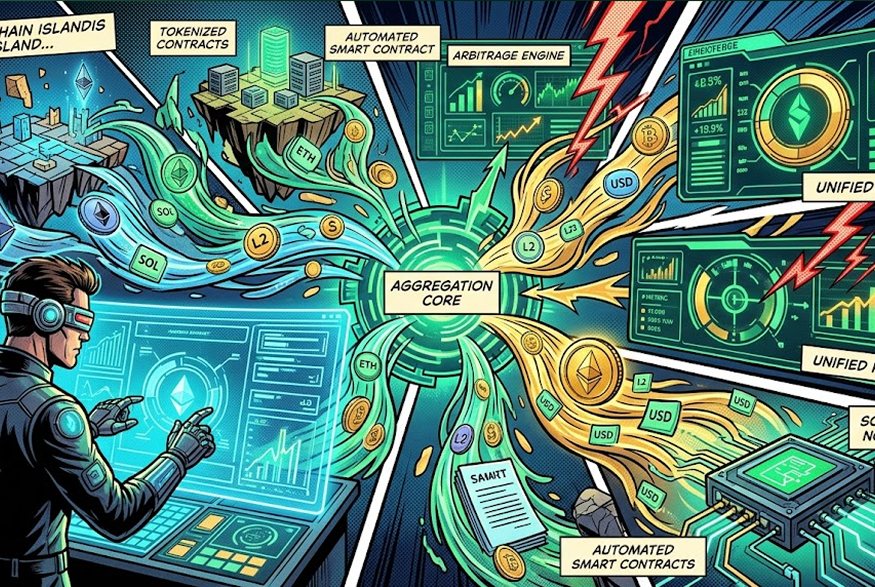
American comic book style artwork illustrating the economic architecture of cross-chain liquidity aggregation layers.

Analyzing cross chain liquidity aggregation layers is essential for understanding how the decentralized economy is combatting its most severe structural bottleneck: capital fragmentation. In the early stages of decentralized finance (DeFi), capital was largely concentrated on Ethereum. Today, the blockchain landscape has splintered into dozens of Layer 1 networks (such as Solana and BNB Chain) … Read more

Cross-Chain DeFi Tax Transparency Guidelines: CARF & DAC8 Guide

American comic book style artwork illustrating global tax transparency guidelines monitoring cross-chain DeFi transfers.

Adhering to cross chain defi tax transparency guidelines is now a fundamental requirement for decentralized liquidity protocols, cross-chain bridges, and institutional Web3 desks. Historically, decentralized finance operated under the assumption that pseudonymous smart contract interactions existed outside the reach of traditional sovereign reporting mandates. Unlike centralized exchanges that collect customer data at account creation, decentralized … Read more

Wholesale CBDC Settlement Rails: Global Interbank Evolution

American comic book style artwork illustrating wholesale CBDC settlement rails transforming interbank liquidity and cross-border finance.

Deploying modern wholesale cbdc settlement rails represents the most significant architectural overhaul of international central banking infrastructure in half a century. While consumer-facing retail CBDCs frequently face public pushback regarding financial privacy and surveillance, wholesale Central Bank Digital Currencies (wCBDCs) operate exclusively between central banks, licensed commercial institutions, and clearing houses. The core focus is … Read more

How to Calculate Slashing Risk in Restaking and AVS Protocols

American comic book style artwork illustrating a risk analyst modeling slashing scenarios across restaking and AVS protocols.

Learning how to calculate slashing risk restaking avs networks is a core discipline for liquidity providers, risk committees, and Liquid Restaking Token (LRT) protocols. In traditional Proof-of-Stake (PoS), an Ethereum validator’s slashing exposure is strictly bounded: penalties occur almost exclusively due to double-signing, surround voting, or prolonged inactivity on the Beacon Chain. Because Ethereum client … Read more

Verifiable AI Compute Prediction Markets: Oracle Security Guide

American comic book style artwork illustrating verifiable AI compute securing decentralized prediction markets against oracle exploits.

Deploying verifiable ai compute prediction markets architectures addresses the most vulnerable bottleneck in decentralized forecasting: the oracle resolution problem. While automated market makers and order books allow prediction platforms to trade millions of dollars on geopolitical elections, macroeconomic indices, sports, and court rulings, the ultimate payoff of every contract hinges on an external party answering … Read more

Data Availability Sampling Light Clients: Modular Blockchain Guide

American comic book style artwork illustrating data availability sampling enabling light clients to secure modular blockchain architectures.

Deploying data availability sampling light clients represents the fundamental architectural breakthrough that makes modular blockchains scalable without compromising decentralization. In traditional monolithic blockchains like Bitcoin or standard Ethereum, network participants face a strict binary choice: either run a resource-intensive full node that downloads and validates every byte of block data, or operate a lightweight client … Read more